
The AI Smart Solar Bench: Edge Computing Infrastructures in Conscious Urban Furniture and Decentralized Micro-Hubs
Why the DoubleSlit AI layer on every Smart Bench processes on the device itself rather than waiting on a central server — and what that decision buys a network of benches when the connection back to the ICCC actually drops.
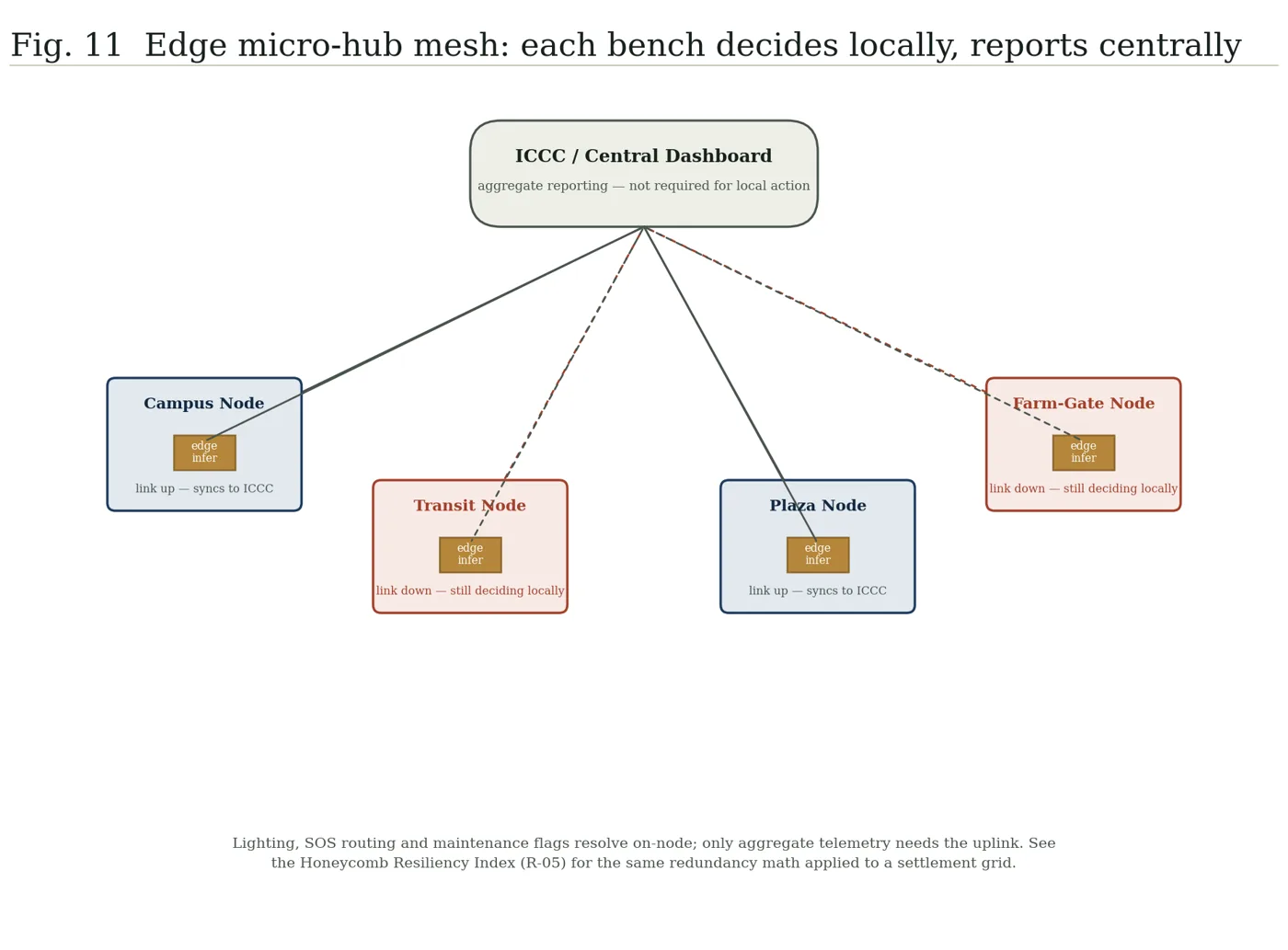
The AI Smart Solar Bench’s product specification covers what the unit does — solar generation, Wi-Fi, environmental sensing, an SOS button. This piece is about where the thinking happens: specifically, why DoubleSlit AI processes most of its decisions on the bench itself, at the edge, rather than sending every reading to a central server and waiting for an instruction back.
Three constraints drive that choice, and all three are more pronounced in exactly the settings a Smart Bench gets deployed into. Latency is the clearest: an SOS button press needs to trigger a local alert sequence in a fraction of a second, not after a round trip to a cloud service that may itself be under load during the emergency that triggered the press in the first place. Bandwidth is the second: a unit relying on a 4G/3G relay in a low-connectivity transit corridor or an emergency deployment zone under DM-04 simply doesn’t have the throughput to stream every sensor reading upstream continuously and wait for a response. Resilience is the third and most direct: if the uplink to a central ICCC dashboard drops — the exact grid and network failure scenario the emergency deployment use case exists to survive — a bench that depends on that link for every decision goes dark at precisely the moment it’s needed most.
Edge processing addresses all three by keeping the decisions that need to be immediate and local — adaptive lighting response, predictive maintenance flagging, SOS routing — resolved on the unit itself, while reserving the uplink for what it’s actually good for: aggregate reporting that feeds a facilities team’s dashboard or an ICCC’s city-wide picture, where a few seconds or minutes of latency genuinely doesn’t matter. That split is what “conscious urban furniture” means in practice — not a marketing flourish, but a specific claim that the bench acts on its own sensing before it reports that sensing anywhere else.
Read as a network rather than as individual units, a “digital forest” deployment of Smart Benches across a campus or promenade is a decentralized micro-hub mesh in the same structural sense the Honeycomb Resiliency Model applies to a settlement layout: each bench is a node capable of independent function, and the uplink to a central dashboard is one edge among several rather than the only path a node has to being useful. The same redundancy math that shows a six-gate settlement absorbing a single severed route applies here almost unchanged — a bench network with edge-resident intelligence degrades gracefully, node by node, rather than failing all at once the moment one central link goes down.
The practical upshot for anyone specifying a multi-unit deployment is a design question worth asking explicitly at the RFP stage: does a given smart-furniture product make its core safety and comfort decisions locally, or does it merely display sensor data while waiting on a central system to tell it what to do? The AI Smart Solar Bench is built to do the former — which is also, not incidentally, why it remains useful as an emergency node under Disaster Management’s DM-04 scope, where the central network is often the first thing to fail.
Part of the ArthAxis Research Lab. Builds on R-01: ArthAxis Planning Theory. Read the citation →
More from ArthAxis Research Lab
ArthAxis Planning Theory
The internal framework behind every ArthAxis master plan — one spatial pattern, read at every scale from a nation down to a single courtyard.
R-02 · 7 MINFort-Gate Urbanism
A defensive fort-and-gate settlement pattern, translated into a hexagonal "honeycomb" topology — so a city, campus or farm site has more than one way to keep functioning when a single route fails.
R-03 · 6 MINThe Techno-Organic Harmony Model
An algorithmic substrate for keeping a building, plaza or farm site in active symbiosis with the biological life around it — not just leaving room for a few trees at the boundary.