
ArthAxis Planning Theory: Reading a Site at Every Scale Before Drawing a Line
The internal framework behind every ArthAxis master plan — one spatial pattern, read at every scale from a nation down to a single courtyard.
Most master plans start from a survey drawing: a plot boundary, a zoning code, a setback line. ArthAxis Planning Theory starts one step earlier, with a different question — what pattern actually repeats at every scale of a site, from the civilisational down to the individual community, and can a single spatial logic describe all of them at once. That question is what lets a "smart, sustainable" brief and a "sacred, traditional" one sit on the same drawing instead of competing for it.
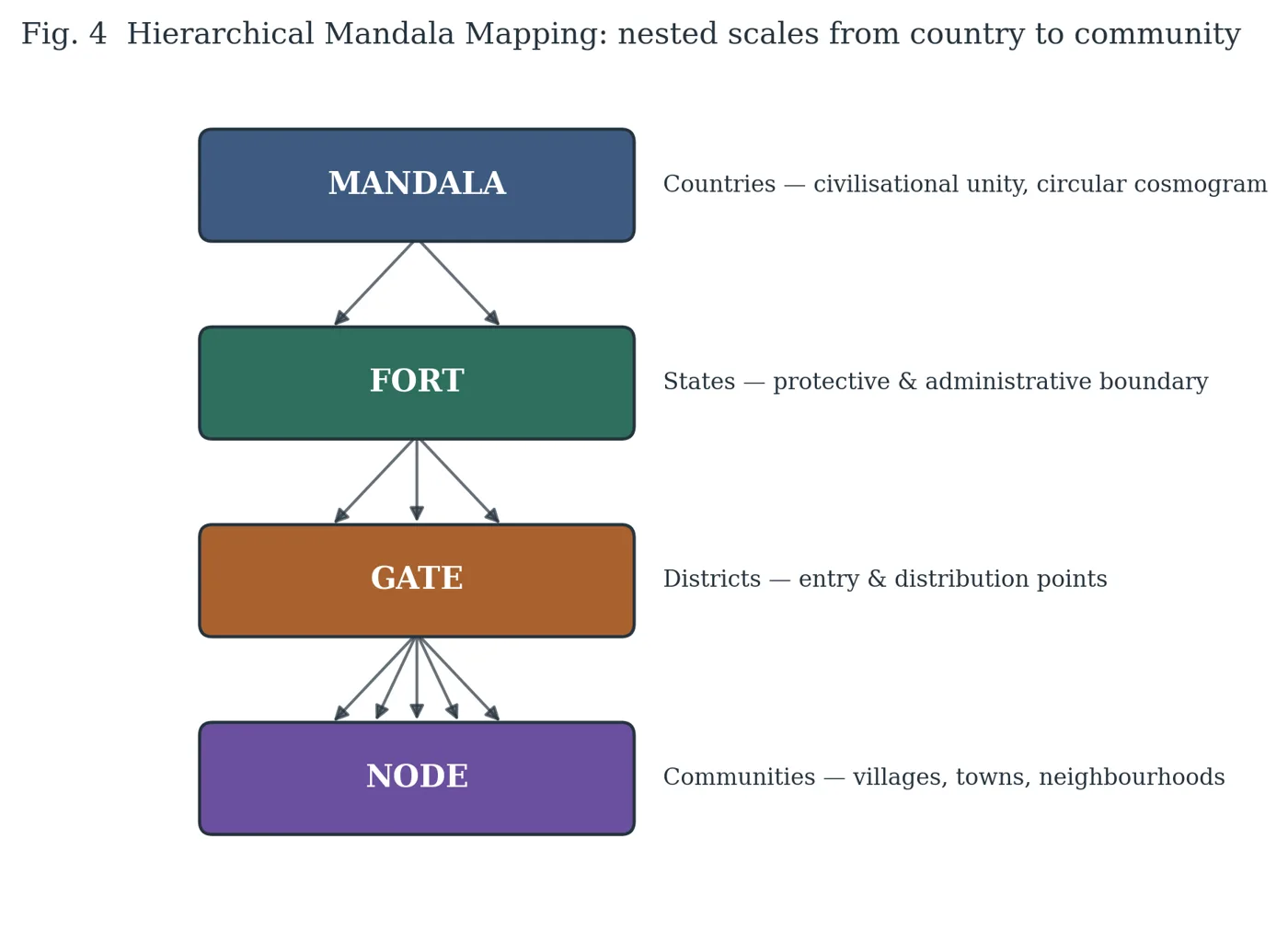
The clearest expression of the theory is a four-tier hierarchy: Mandala, Fort, Gate, Node. At country scale, a Mandala is a circular cosmogram — the traditional South Asian planning device for civilisational unity, a centre surrounded by concentric, symbolic order. At state scale, that same logic becomes a Fort: a protective, administrative boundary. At district scale it becomes a Gate: a distribution and entry point, controlling what moves in and out. And at community scale it becomes a Node: the village, town or neighbourhood anchor everything else was ultimately organised to serve. Each tier is a scaled echo of the one above it, not a separate design problem.
In practice, that changes where a master plan actually begins. Instead of starting at the plot boundary and working inward, an ArthAxis layout starts by locating the node — the community anchor, whether that is a heritage core, a market square or, on an ArthAxis GROW site, the working production core — and grows outward from it in the same spiral logic the theory predicts at every other scale: an inner heritage nucleus, a middle band of markets, housing and institutions, and an outer band of regenerative agriculture and commons. The companion piece on the Techno-Organic Harmony Model walks through that spiral in more technical detail.
The theory is deliberately not confined to greenfield townships. The same Mandala-to-Node reading is what shapes CLU and Zonal Development Plan filings for large-scale master planning work, and how an ArthAxis GROW site's three farm parcels are zoned relative to each other — see Fort-Gate Urbanism for how the Fort and Gate tiers get built out at district and neighbourhood scale specifically.
What the theory ultimately buys a client is coherence across scale: a single 7-bigha farm site, a six-gate distribution layout and a multi-corridor township masterplan are all readable as the same four-tier pattern, just zoomed to a different level. That is what "spatial engineering" means at ArthAxis in practice — not a style, but a method for making sure a plaza, a district and a state read as one continuous idea rather than three unrelated briefs.
This framework has since been written up in full as a standalone paper — the theoretical foundations, the planning technique itself, worked applications across resilient city design, and a candid account of the simulation and field validation still required before it moves from conceptual framework to applied practice — published under an open-access licence. The Fort-Gate Urbanism, Techno-Organic Harmony and Honeycomb Resiliency pieces on this page are the applied, project-facing reading of that same paper; the citation below links to the source document itself.
ArthAxis Planning Theory: Reading a Site at Every Scale Before Drawing a Line
Yatish Parashar · The Great Indian Campus / iViRTH · Preprint · 2024 · CC BY 4.0
Parashar, Y. (2024). ArthAxis Planning Theory & Technique — A Regenerative Spiral Model for Urban and Regional Design (Version v1) [Preprint]. Zenodo. https://doi.org/10.5281/zenodo.21222939
More from ArthAxis Research Lab
Fort-Gate Urbanism
A defensive fort-and-gate settlement pattern, translated into a hexagonal "honeycomb" topology — so a city, campus or farm site has more than one way to keep functioning when a single route fails.
R-03 · 6 MINThe Techno-Organic Harmony Model
An algorithmic substrate for keeping a building, plaza or farm site in active symbiosis with the biological life around it — not just leaving room for a few trees at the boundary.
R-04 · 6 MINThe Waste-to-Wealth Framework
Turning a site's waste stream into a sorted, tracked input rather than an unexamined output — using the same AI sensing layer already deployed across ArthAxis's IoT hardware.