
Fort-Gate Urbanism: Polycentric Honeycomb Layouts for Resilient Cities
A defensive fort-and-gate settlement pattern, translated into a hexagonal "honeycomb" topology — so a city, campus or farm site has more than one way to keep functioning when a single route fails.
A traditional fort town rarely relies on one entrance. It organises around a small number of gates, and — deliberately or not — each gate tends to end up responsible for a different category of movement: supplies through one, worshippers or traders through another, water carriers through a third. Fort-Gate Urbanism takes that historical pattern and formalises it as a polycentric topology for modern civil infrastructure, built for decentralised, resilient access rather than a single grand entrance.
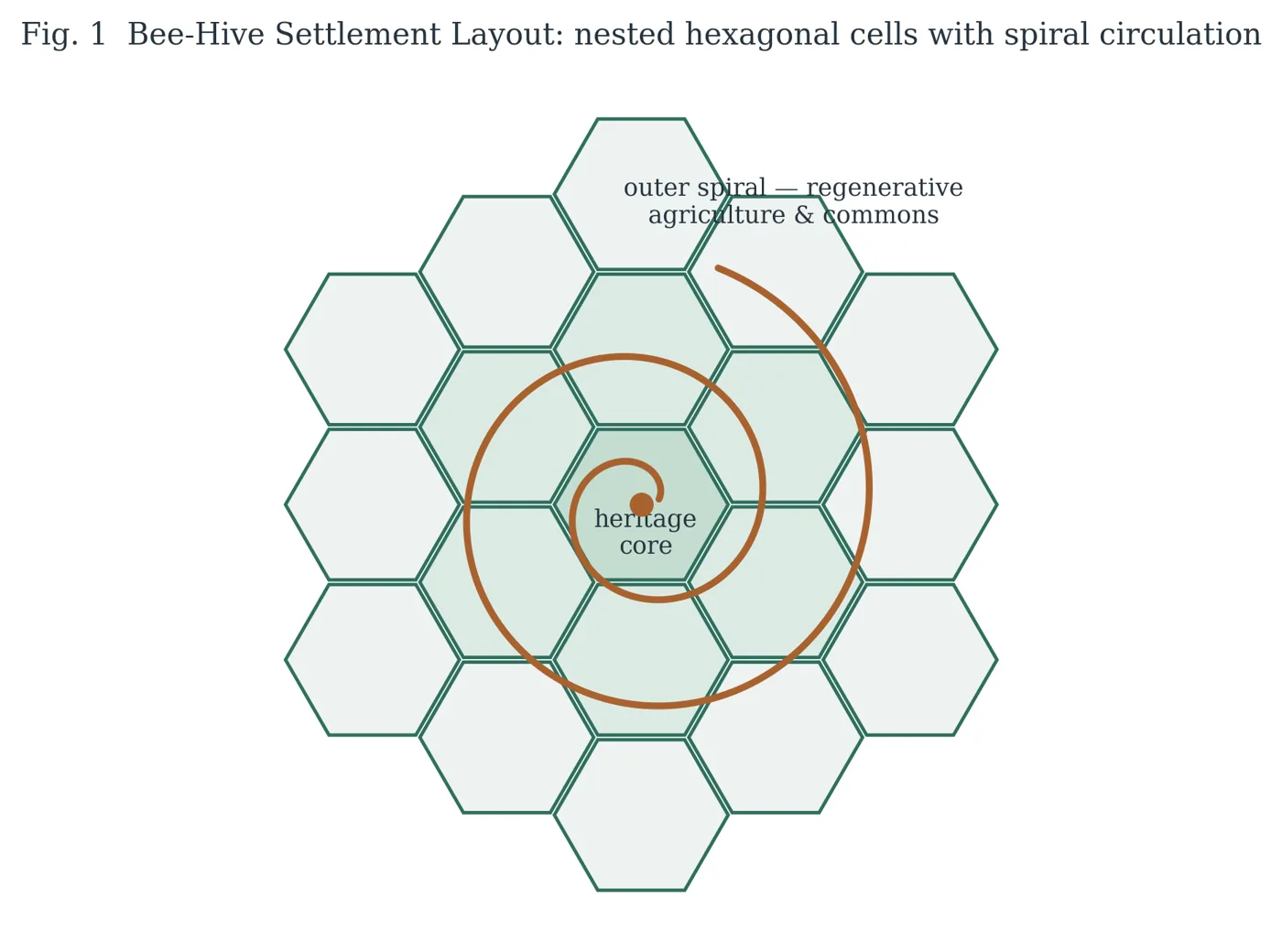
The base unit is a hexagonal cell rather than a square block. A hexagon shares an edge with six neighbours instead of a grid block's four, which means there are more independent paths between any two points in the settlement — congestion or damage on one edge doesn't isolate a cell the way it can in a rigid grid. Nested together, these cells form a bee-hive settlement pattern: a protected heritage core at the centre, with growth spiralling outward through the honeycomb rather than sprawling as an unbounded grid. It is the same spiral logic described in ArthAxis Planning Theory, expressed here at the scale of an actual street layout.
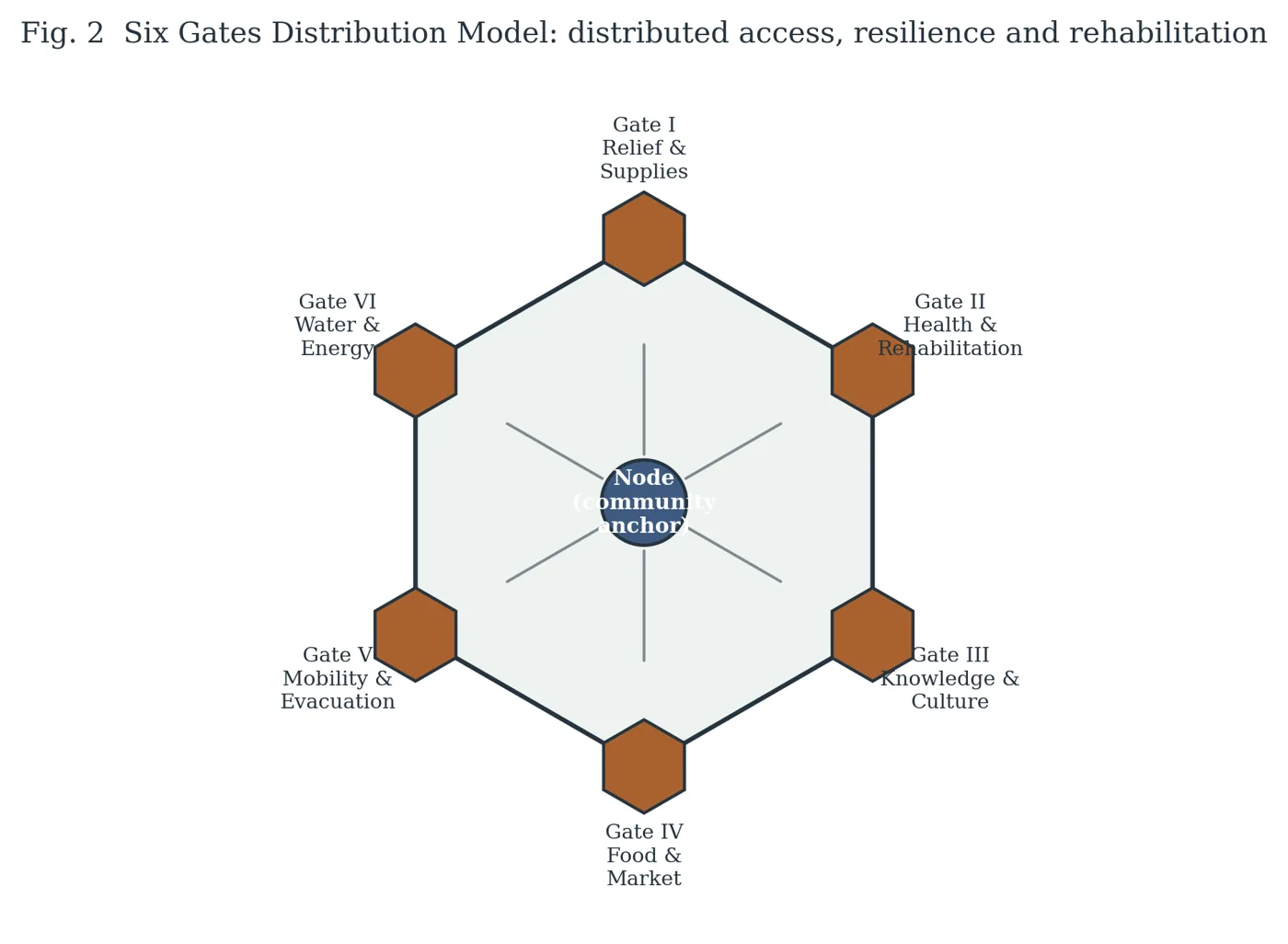
The "Gate" half of the model is where the resilience case really shows up. Rather than one generic entrance trying to carry every function, a Fort-Gate node is served by six specialised gates arranged around a central community anchor: Gate I for relief and supplies, Gate II for health and rehabilitation, Gate III for knowledge and culture, Gate IV for food and market activity, Gate V for mobility and evacuation, and Gate VI for water and energy. Splitting function by gate means that damage, congestion or a security incident at any single gate degrades one category of service rather than the whole settlement — a distinction that matters just as much for a Tuesday-morning market delivery as it does in an actual emergency.
This same gate-by-gate logic is what makes the model useful for planning displaced-community resettlement rather than as one undifferentiated relief camp. It also shapes something as ordinary as an ArthAxis GROW farm site's own access points: produce leaves through a dedicated food-and-market gate, subscriber visits route through a separate node, and utility access for irrigation and power stays independent of both — so a single blocked driveway never has to double as every function a working farm site needs at once.
Zoomed out, a Fort-Gate cell is simply what the "Fort" and "Gate" tiers of ArthAxis Planning Theory look like once you get down to district and neighbourhood scale — the honeycomb is the plan-view version of the same nested hierarchy, not a separate system.
Part of the ArthAxis Research Lab. Builds on R-01: ArthAxis Planning Theory. Read the citation →
More from ArthAxis Research Lab
ArthAxis Planning Theory
The internal framework behind every ArthAxis master plan — one spatial pattern, read at every scale from a nation down to a single courtyard.
R-03 · 6 MINThe Techno-Organic Harmony Model
An algorithmic substrate for keeping a building, plaza or farm site in active symbiosis with the biological life around it — not just leaving room for a few trees at the boundary.
R-04 · 6 MINThe Waste-to-Wealth Framework
Turning a site's waste stream into a sorted, tracked input rather than an unexamined output — using the same AI sensing layer already deployed across ArthAxis's IoT hardware.